Padel vs Tennis: 10 Key Differences Explained

Padel vs Tennis: Key Differences, Rules, Courts and Equipment
Padel vs. tennis is becoming a popular comparison as more players across the UAE discover padel for the first time. Both are exciting racket sports that involve a net, a ball, and many similar scoring rules. However, the court design, equipment, serving technique, playing format, and match strategy are noticeably different.
Tennis is a globally established sport known for powerful serves, long baseline rallies, and demanding court coverage. Padel, meanwhile, is normally played in doubles on a smaller enclosed court where the glass walls remain part of the game.
This complete guide explains the main differences between padel and tennis, helping beginners, families, and experienced tennis players decide which game best suits their goals.
Padel vs Tennis: Quick Comparison
| Feature | Padel | Tennis |
|---|---|---|
| Standard court | 20m × 10m | 23.77m × 8.23m for singles or 10.97m for doubles |
| Court enclosure | Glass walls and metal fencing | Open court without playable walls |
| Common format | Doubles | Singles and doubles |
| Racket | Solid face with holes and no strings | Larger frame with strings |
| Serve | Underarm after bouncing the ball | Usually overarm without bouncing the ball |
| Ball | Similar appearance with different pressure requirements | Made according to tennis-specific standards |
| Walls in play | Yes, after the ball bounces correctly | No |
| Learning curve | Generally easier for beginners to start | Usually requires more time to develop serving and stroke technique |
| Playing style | Tactical, social and position-focused | Powerful, athletic and stroke-focused |
What Is Padel?
Padel is a racquet sport usually played by four people in a doubles format. The game takes place on a compact court surrounded by glass walls and metal fencing. Like tennis, players hit the ball over a central net and use the familiar 15, 30, and 40 scoring sequence.
However, padel introduces an important tactical feature: the ball can rebound from the walls after landing inside the court. As a result, a shot that appears to have passed a player can still be returned after rebounding off the glass.
The sport combines quick reactions, controlled strokes, teamwork, and intelligent positioning. It is also highly social because partners must communicate continuously and move together as a team.
New players can learn more in our guide to what padel is and why it is growing worldwide.
What Is Tennis?
Tennis is played on a larger open court using stringed rackets. It can be played as singles between two players or doubles between teams of two. The objective is to strike the ball over the net and into the opponent's court while preventing a successful return.
The game rewards strong serving, accurate groundstrokes, footwork, endurance, and the ability to cover a large area. Singles tennis can be especially physically demanding because one player must defend the entire side of the court.
Tennis does not use surrounding walls as part of normal play. Therefore, when the ball lands outside the permitted lines or cannot be returned before its second bounce, the point ends.
1. Padel Court vs Tennis Court
Padel court dimensions
A standard padel court measures 20 meters long and 10 meters wide. It is divided by a net and enclosed by a combination of walls and fencing.
The enclosed design is central to padel. After the ball bounces inside the court, it may rebound from the glass and remain playable. Players must therefore judge angles and rebounds instead of only tracking the ball's direct path.
Tennis court dimensions
A full tennis court measures 23.77 meters long. It is 8.23 meters wide for singles and 10.97 meters wide for doubles.
Although the difference in marked playing width may not appear enormous, tennis normally requires considerably more surrounding clearance. Tennis players also cover more open ground, particularly during singles matches.
You can review the formal specifications through the International Padel Federation rules and the International Tennis Federation rules.
Typical playing surfaces
Padel courts commonly use artificial turf, although the exact surface and sand distribution can vary. Tennis is played on several major surfaces, including:
- Hard courts
- Clay courts
- Grass courts
- Artificial surfaces
Each tennis surface affects ball speed, bounce, and movement. In padel, players must additionally consider how the ball responds to the glass, fence, and artificial turf.
2. Padel Racket vs Tennis Racket
The rackets are among the easiest differences to recognize.
Padel rackets
A padel racket has a solid hitting surface with multiple holes and does not contain strings. It is shorter and more compact than a tennis racket. Most models use materials such as carbon fiber, fiberglass, and EVA foam.
Padel rackets are commonly available in three shapes:
- Round: Usually offers a larger sweet spot and better control for beginners.
- Teardrop: Balances power and control for improving players.
- Diamond: Places more weight towards the head and is often selected by attacking players.
Read our detailed padel racket buying guide to compare weight, shape, balance, material, and skill level.
Players looking for balanced power and control can explore the VEA AEROVOLT Professional Padel Racket. Its teardrop profile and carbon fiber construction are designed for intermediate and experienced players.
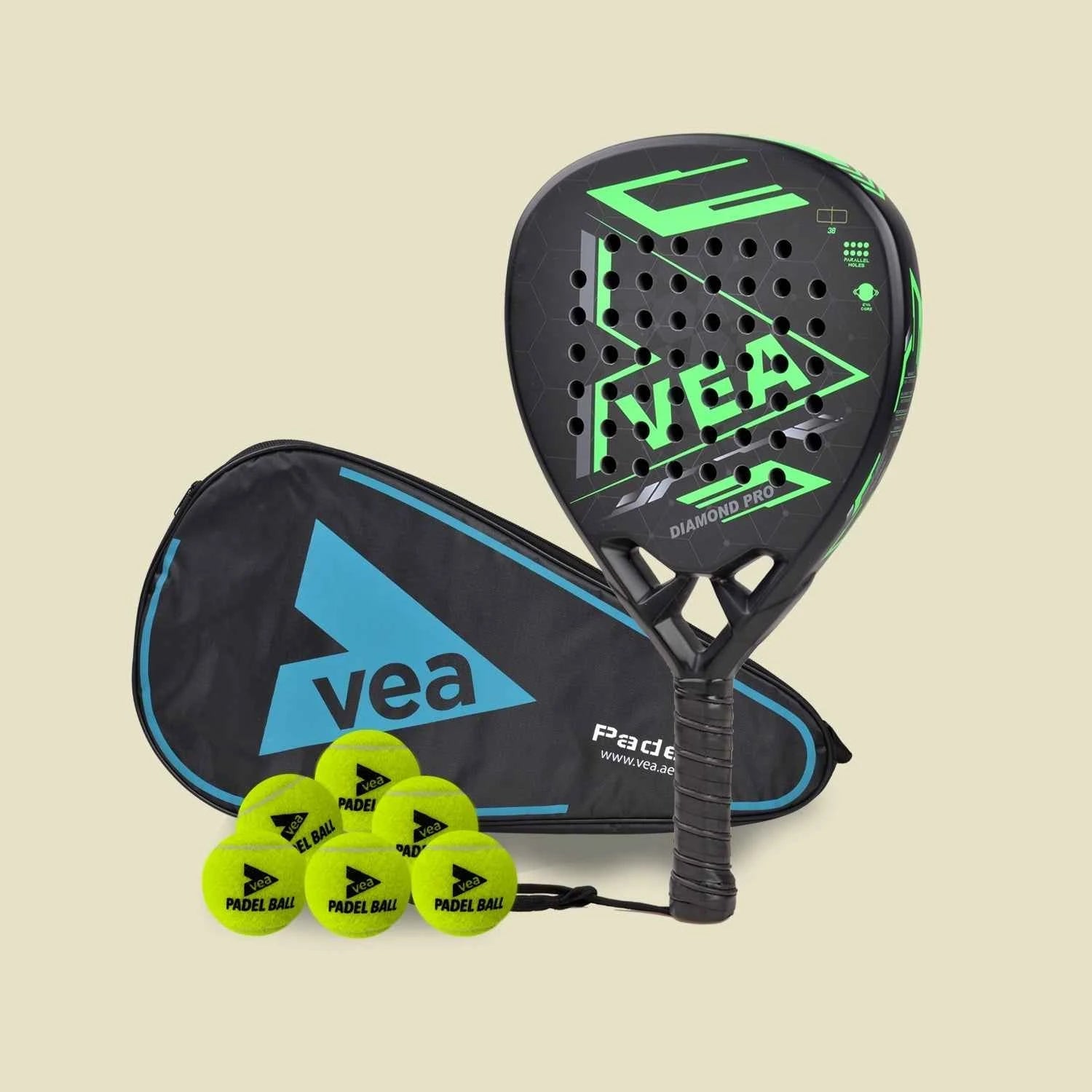
For an attacking style, the VEA Diamond Pro Padel Racket provides a power-focused diamond shape.
Beginners and families can compare additional models in the VEA padel racket collection.
Tennis rackets
Tennis rackets have a larger oval head containing a network of strings. The strings generate pace, spin, and ball response. Tennis players must consider head size, string tension, racket weight, grip size, and balance when selecting equipment.
A tennis racket also has a longer handle and greater overall length, which helps players generate leverage during serves and groundstrokes.
3. Padel Ball vs Tennis Ball
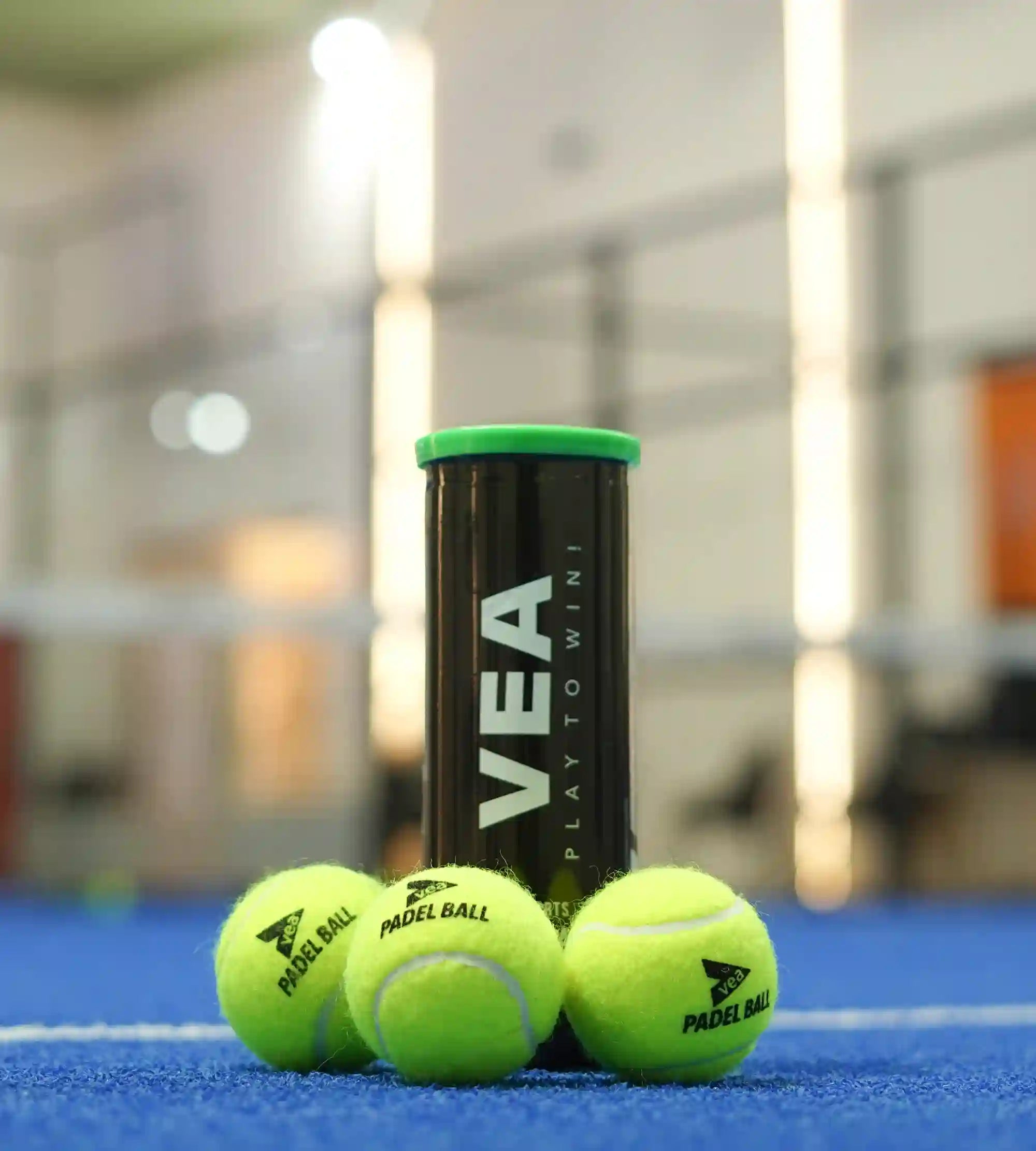
Padel and tennis balls look very similar, but they are manufactured for their respective sports and must meet different specifications. Their permitted pressure and rebound ranges are not identical.
Using a proper padel ball helps deliver a more suitable speed and rebound for the smaller enclosed court. A tennis ball may feel faster or behave differently against the glass, depending on its construction and condition.
For regular matches and training sessions, explore the VEA padel ball collection. You can also read our guide to selecting the right padel balls for UAE matches.
4. Rules, Serving and Scoring
Scoring
Traditional padel and tennis scoring are closely related. A standard game generally progresses through:
- 15
- 30
- 40
- Game
Players compete to win games and sets. Exact match formats, tiebreak rules, and deciding-point systems can vary according to the competition or club.
Serving in padel
In padel, the server first bounces the ball behind the service line and strikes it underarm at or below the permitted height. The serve travels diagonally into the opponent's service box.
The underarm action is generally easier for a new player to start than a full tennis serve. Nevertheless, placement, depth, and variation remain important at competitive levels.
Serving in tennis
A tennis serve is usually struck overhead. The server tosses the ball into the air and attempts to direct it diagonally into the correct service box.
Producing a reliable tennis serve requires coordination, timing, shoulder action, and control. It can take considerable practice before a beginner develops both consistency and speed.
Using the walls in padel
During a padel rally, the opponent's shot must normally bounce in the court before it contacts the surrounding wall or fence. After a legal bounce, the receiving player may allow the ball to rebound from the glass before returning it.
This creates defensive opportunities that do not exist in tennis. Instead of immediately chasing every ball, skilled padel players often step back, read the rebound, and play a controlled return.
5. Playing Style and Match Strategy
Padel focuses on position and teamwork
Padel rewards communication, net control, patience, and intelligent shot selection. Because the court is compact and the walls keep many rallies alive, pure power is not always enough.
Important paddle shots include:
- Controlled volleys
- Lobs
- Wall rebounds
- Bandejas
- Viboras
- Smashes
- Low defensive returns
A well-placed lob can be more effective than a powerful groundstroke because it pushes opponents away from the net and creates an opportunity to improve court position.
New players can improve their decision-making with these practical padel tips for beginners.
Tennis gives individual strokes greater importance
Tennis strategy varies substantially between singles and doubles. Singles players may rely on baseline consistency, aggressive serving, court movement, or attacking the net. Doubles players focus more heavily on serving, returning, volleying, and coordinated positioning.
Power and spin can play a larger role because tennis players have more space in which to direct the ball. Deep groundstrokes, wide serves, and passing shots are essential parts of the game.
6. Is Padel Easier Than Tennis?
For many complete beginners, padel is easier to start. Several features make the first session more approachable:
- The serve is underarm.
- The racket is shorter and easier to position.
- The court is smaller.
- Padel is usually played with a partner.
- The walls can keep the rally alive.
- Players can enjoy basic rallies relatively quickly.
However, easy to start does not mean easy to master. Advanced padel requires excellent anticipation, wall awareness, teamwork, net positioning, and shot selection.
Tennis often has a steeper initial learning curve because players must develop a reliable serve, control a longer-stringed racket, and cover more space. Nevertheless, players who enjoy technical stroke development and individual competition may find tennis especially rewarding.
7. Fitness Benefits and Physical Demands
Both sports can support cardiovascular fitness, coordination, balance, agility, and mental well-being. The actual workout depends on match intensity, playing level, duration, and format.
Physical demands of padel
Padel involves frequent short movements, quick changes of direction, and repeated reactions near the net. Its doubles format means players share the court, but long rallies can still provide an energetic workout.
Padel can improve:
- Reaction speed
- Hand-eye coordination
- Lateral movement
- Lower-body agility
- Communication and teamwork
Physical demands of tennis
Singles tennis generally requires greater court coverage and may involve longer sprints. Serving and groundstrokes can also place significant demands on the shoulders, legs, and core.
Tennis can improve:
- Cardiovascular endurance
- Explosive movement
- Full-body coordination
- Strength and stability
- Individual decision-making
Players returning to exercise or managing an existing injury should increase intensity gradually and seek suitable professional advice where necessary.
8. Is Padel More Social Than Tennis?
Padel is generally considered highly social because the standard game includes four players on a compact court. Partners communicate during almost every rally, while regular rotations and club matches make it easier to meet other players.
Tennis can also be social, especially when played as doubles or through group coaching. However, singles tennis creates a more individual competitive experience.
Players who value teamwork and group participation may prefer padel. Those who enjoy one-to-one competition and personal responsibility may be more attracted to singles tennis.
9. Padel vs Tennis for Children
Both sports can help children develop balance, coordination, and confidence. The most appropriate choice depends on the child's age, interest, and access to coaching.
Padel can feel approachable because the court is compact and the serve is simple to begin. However, children should use a racket with manageable weight, grip, and balance.
Parents can view the VEA kids and junior padel racket options and select a model designed for younger players rather than giving a child a heavy adult racket.
Tennis also offers modified programs with smaller courts, lower-compression balls, and shorter rackets, helping children learn progressively.
10. Essential Padel Equipment for Beginners
A new padel player does not need a large collection of equipment. A practical starting setup includes:
- A suitable padel racket
- Proper padel balls
- Supportive court shoes
- Comfortable sports clothing
- Replacement overgrips
- A water bottle
- A protective racket bag or cover
An overgrip helps absorb moisture and maintain a secure hold during hot or intensive sessions. Browse the VEA Racket Overgrip Tape Pack for training and match-day replacements.
You can also review our complete guide to padel equipment essentials in the UAE.
Padel vs Tennis in the UAE
Tennis has an established presence throughout the UAE, with courts available at sports clubs, hotels, schools, residential communities, and academies.
Padel has also developed into a highly visible recreational activity across the country. Indoor facilities make it possible to play during hotter months, while outdoor courts remain popular during cooler weather.
The doubles format works particularly well for social gatherings, corporate activities, family sessions and community leagues. Moreover, the relatively simple starting rules allow groups with mixed experience levels to enjoy a match together.
Learn more about the local growth of the sport in our article on why padel is booming in the UAE.
Should You Choose Padel or Tennis?
Neither sport is automatically better for everyone. Your decision should depend on the experience you want, your fitness goals and the facilities available near you.
Choose padel if you prefer:
- A social doubles game
- A quicker introduction to basic rallies
- Underarm serving
- Wall-based tactics
- A compact court
- Team communication
- Fast reactions and net play
Choose tennis if you prefer:
- Singles competition
- Powerful overhead serving
- Longer court movement
- Developing detailed stroke technique
- Different playing surfaces
- Baseline rallies and open-court angles
- A deeply established competitive structure
If possible, try one beginner session in each sport. Experiencing the court, racket, and pace directly is often the easiest way to make your decision.
Start Playing Padel with VEA
If padel feels like the right sport for you, VEA offers equipment for junior, beginner, intermediate, and experienced players in the UAE.
- Shop VEA padel rackets
- Shop VEA padel balls
- Explore the VEA AEROVOLT
- Explore the VEA Diamond Pro
- Shop VEA overgrip tape
- Browse all VEA products
Frequently Asked Questions About Padel vs Tennis
What is the main difference between padel and tennis?
The main difference is the court and wall system. Padel is usually played as doubles on a smaller enclosed court where the glass walls can remain part of the rally. Tennis is played on a larger open court without playable surrounding walls.
Is padel easier to learn than tennis?
Many beginners find padel easier to start because it uses an underarm serve, a shorter racket and a smaller court. Nevertheless, advanced wall play, positioning and teamwork require considerable practice.
Can I use a tennis racket to play padel?
No. Padel requires a dedicated solid racket with no strings. A tennis racket is longer, strung, and designed for a different ball response and playing environment.
Can I use tennis balls for padel?
Padel and tennis balls may look similar, but they are manufactured according to different permitted specifications. Proper padel balls provide a more suitable bounce and speed for the enclosed court.
Does padel use the same scoring system as tennis?
Traditional padel generally uses tennis-style scoring with 15, 30, 40, games, and sets. However, exact deciding-point and tiebreak formats may vary between competitions.
Is padel always played in doubles?
Padel is primarily designed and officially played as a doubles sport on the standard 20m × 10m court. Some facilities have narrower singles courts, but doubles remains the dominant format.
Can tennis players become good at padel?
Yes. Tennis players often bring useful skills such as volleying, timing, and ball control. However, they must adjust to the shorter racket, underarm serve, compact swings, wall rebounds, and greater importance of team positioning.
Which sport is better for fitness?
Both provide valuable exercise. Singles tennis usually requires more open-court running, while padel includes frequent short movements, rapid reactions, and repeated changes of direction. Match intensity and playing level will influence the overall workout.
Which sport is better for beginners in the UAE?
Padel may be easier for a group of beginners who want a social and accessible game. Tennis may appeal more to someone interested in individual competition and long-term technical stroke development. Both sports have coaching and court options across the UAE.
Is padel replacing tennis?
Padel is growing quickly, but it should be viewed as a different sport rather than simply a replacement for tennis. Many players enjoy both because each offers a distinct combination of technique, movement, and strategy.
Final Verdict: Padel vs Tennis
When comparing padel vs. tennis, the right choice depends on the type of game you enjoy. Tennis offers open-court movement, powerful serving, individual competition, and detailed stroke development. Padel offers wall-based tactics, teamwork, quick reactions, and an accessible social format.
For UAE players who want a game that is easy to begin, energetic, and enjoyable with friends, padel is an excellent option. Meanwhile, players who prefer singles competition and a more traditional technical challenge may favor tennis.
Whichever sport you choose, consistent practice, suitable equipment, and good technique will help you play more confidently and enjoy every session.