Choosing the Perfect Padel Racket Made Simple

Which Padel Racket Should You Buy? Complete Guide
Which padel racket should you buy? The answer depends on your playing level, preferred style, physical strength and the balance of control and power you need on the court.
A beginner may benefit from a lightweight round racket with a generous sweet spot. Meanwhile, an attacking player may prefer a diamond-shaped racket that produces greater power during volleys and smashes. An all-round player may feel most comfortable with a teardrop racket that offers a balance between the two.
Buying the wrong racket can make your shots less consistent and may place unnecessary strain on your wrist, elbow or shoulder. Therefore, it is important to compare racket shape, weight, balance, surface material and core before making a decision.
This complete padel racket buying guide explains each factor in simple terms. It also includes recommendations for beginners, intermediate players, advanced players, juniors and UAE players looking for dependable padel equipment.
Quick recommendation: Beginners should normally prioritise control, comfort and a large sweet spot. Intermediate players can consider a teardrop racket, while experienced attacking players may benefit from a powerful diamond-shaped model.
Why Choosing the Right Padel Racket Matters
Your padel racket influences your control, power, comfort and confidence. Although good technique remains more important than expensive equipment, a suitable racket makes it easier to develop that technique.
A racket that suits your ability can help you:
- Make cleaner contact with the ball
- Control defensive shots more comfortably
- Generate suitable power without forcing your swing
- React more quickly at the net
- Reduce unnecessary strain on your arm
- Improve consistency during longer rallies
- Develop confidence as your skills improve
In contrast, a racket that is too heavy, too hard or too head-heavy may be difficult to manoeuvre. Beginners sometimes select an advanced power racket because they like its appearance, only to discover that it is harder to control.
If you are completely new to the sport, read our introduction to what padel is and why it is growing worldwide before selecting your first racket.
Padel Racket Shapes Explained
Padel rackets are generally grouped into three main shapes: round, teardrop and diamond. Each shape changes the location of the sweet spot and affects the balance between control and power.
| Racket Shape | Main Benefit | Typical Balance | Best Suited To |
|---|---|---|---|
| Round | Control and forgiveness | Low or even | Beginners and defensive players |
| Teardrop | Balance of power and control | Medium | Intermediate and all-round players |
| Diamond | Power and attacking performance | High | Advanced and attacking players |
1. Round Padel Rackets
A round padel racket usually has its sweet spot close to the centre of the face. The sweet spot is the area that produces the most effective response when the ball makes contact.
Because the effective hitting area is normally generous and centrally positioned, round rackets tend to be forgiving when contact is not perfect. They are commonly associated with control and ease of handling.
Advantages of round rackets
- Large and accessible sweet spot
- Good control during defensive shots
- Easy manoeuvrability near the net
- Suitable for developing basic technique
- Often more comfortable for beginners
Possible disadvantages
- May produce less effortless power than a diamond racket
- Highly aggressive players may eventually want more head weight
A round racket is often the safest starting point when you are buying your first padel racket and do not yet have a defined playing style.
2. Teardrop Padel Rackets
A teardrop racket sits between a round and diamond model. Its sweet spot is generally positioned slightly above the centre, while its balance is commonly medium rather than extremely low or high.
This design can offer useful power without sacrificing too much control. For that reason, teardrop rackets are popular among intermediate players and anyone who wants an adaptable all-round racket.
Advantages of teardrop rackets
- Balanced combination of control and power
- Suitable for defensive and attacking play
- Good option as a player progresses
- More forgiving than many diamond rackets
- Useful for players who do not want an extreme balance
Who should buy a teardrop racket?
Consider a teardrop racket when you can maintain regular rallies, understand basic positioning and want to add more power without losing too much control.
The VEA AEROVOLT Professional Padel Racket uses a teardrop profile and is designed for players seeking a combination of manoeuvrability, control and attacking potential.
3. Diamond Padel Rackets
A diamond padel racket generally carries more weight towards the upper part of the head. Its sweet spot is also positioned higher than that of a typical round racket.
This structure can increase leverage during smashes, volleys and attacking overhead shots. However, it may also make the racket feel less forgiving when the ball misses the ideal contact area.
Advantages of diamond rackets
- Strong power potential
- Useful for aggressive net play
- Effective for experienced smashers
- Can add weight and penetration to attacking shots
Possible disadvantages
- Smaller or higher sweet spot
- More demanding for beginners
- Head-heavy feel may reduce manoeuvrability
- May feel tiring during long sessions
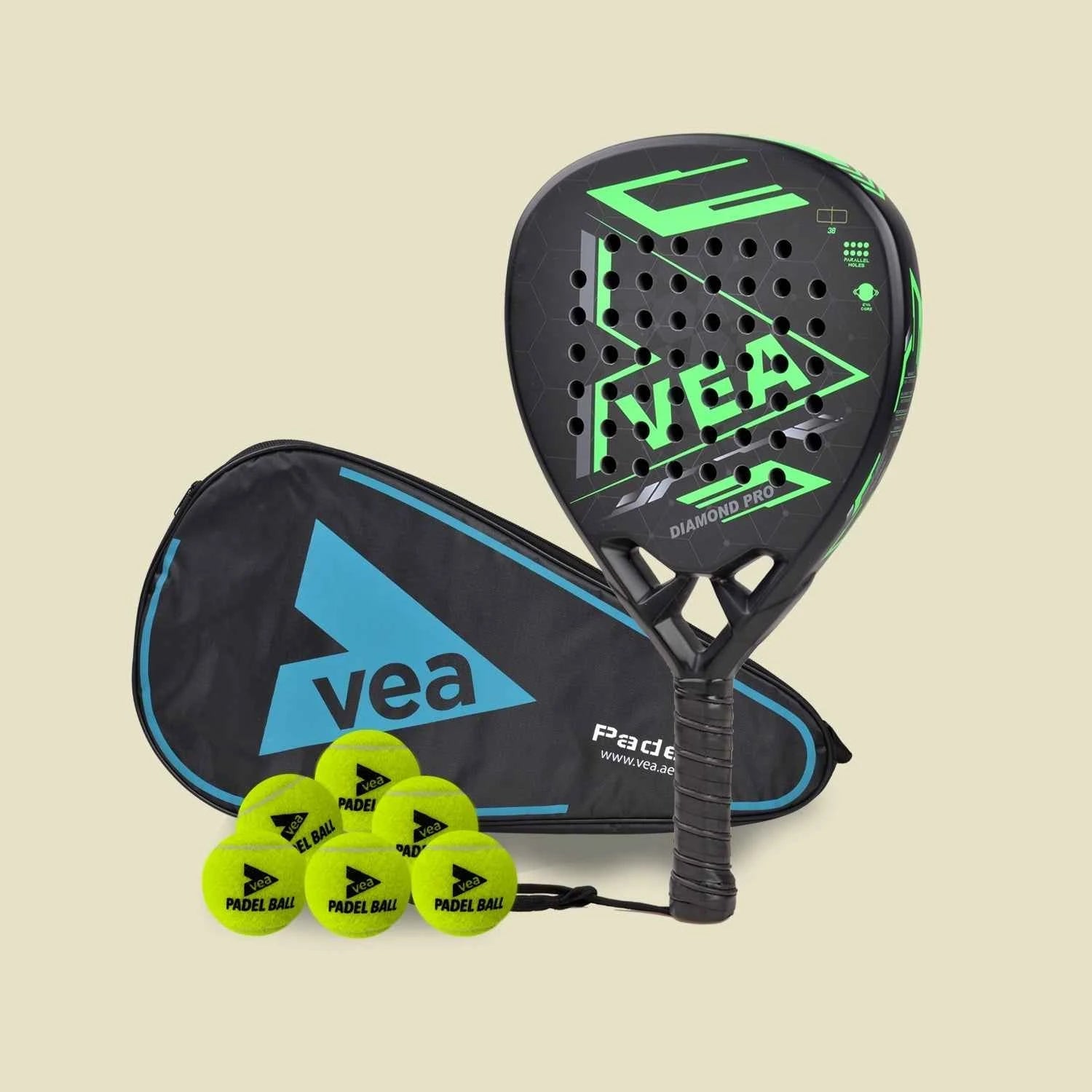
The VEA Diamond Pro Padel Racket is intended for players who want a power-focused shape and a carbon construction suited to competitive play.
Important: A diamond racket is not automatically better than a round racket. The best racket is the one that matches your ability, technique, and playing style.
How to Choose the Correct Padel Racket Weight
Racket weight affects speed, stability, power, and comfort. A lighter racket is usually easier to move, while a heavier model can feel more stable when returning fast shots.
However, the printed weight does not tell the complete story. Two rackets with the same total weight may feel very different if one has a low balance and the other carries more weight towards the head.
Lighter padel rackets
A lighter racket may be suitable for:
- Beginners
- Junior players
- Players who value quick handling
- Players with limited upper-body strength
- Anyone concerned about arm fatigue
Lighter rackets can make it easier to prepare quickly for volleys and defensive returns. Nevertheless, a racket that is excessively light may feel less stable against powerful shots.
Heavier paddle rackets
A heavier racket may provide the following:
- Greater stability at impact
- Additional momentum through the ball
- More confidence when blocking fast volleys
- Extra power for physically strong players
The trade-off is that a heavier racket demands more strength and may become tiring during a long match. Avoid selecting the heaviest available option simply because it appears more powerful.
Practical weight recommendation
Most adult players use rackets within the normal adult weight range offered by established manufacturers. Instead of focusing on a single number, compare the racket's total weight, balance and ease of movement together.
When possible, hold the racket and perform a few controlled practice swings. It should feel stable without pulling your wrist or making your preparation noticeably slow.
Understanding Low, Medium and High Balance
Balance describes where the racket's weight is concentrated.
Low balance
A low-balance racket carries more of its weight near the handle. This makes the head easier to move and can improve comfort during rapid exchanges.
Low balance is commonly suitable for beginners, defensive players, and anyone prioritizing maneuverability.
Medium balance
A medium-balance racket distributes weight more evenly. It offers a compromise between easy handling and power, making it useful for versatile players.
High balance
A high-balance racket places more weight towards the top of the head. This can help create power but may require greater wrist, forearm and shoulder strength.
Advanced attacking players often appreciate a higher balance, while a beginner may find it harder to control.
| Balance | Feeling | Primary Benefit | Recommended For |
|---|---|---|---|
| Low | Quick and easy to move | Control and comfort | Beginners and defensive players |
| Medium | Balanced and versatile | Control with useful power | Intermediate and all-round players |
| High | Powerful but demanding | Attacking power | Experienced attacking players |
Carbon Fibre vs Fibreglass Padel Rackets
Padel racket frames and faces are commonly made using carbon fibre, fibreglass or a combination of materials. The construction influences durability, flexibility, response and price.
Fibreglass padel rackets
Fibreglass is generally more flexible than carbon fibre. This flexibility can produce a softer and more comfortable response, particularly at lower swing speeds.
Fibreglass rackets are commonly suitable for:
- New players
- Recreational players
- Players who prefer a softer feeling
- Buyers seeking an accessible first racket
However, fibreglass may not offer the same stiffness or long-term resistance as higher-grade carbon constructions.
Carbon-fibre padel rackets
Carbon fibre is usually firmer and more resistant. Depending on the complete racket design, it can provide a precise response and improved stability during powerful contact.
Carbon rackets are commonly selected by:
- Intermediate players
- Advanced competitors
- Players seeking a firmer response
- Players who hit with greater speed
- Buyers prioritising performance and durability
Hybrid construction
Some rackets combine a carbon frame with a fibreglass face or mix different fibres within the surface. A hybrid design can balance comfort, durability and price.
Do not judge a racket only by the word “carbon.” The amount, weave, core, frame design and overall construction also influence how the racket performs.
Soft EVA vs Medium EVA vs Hard EVA
The inner core is another important component. Many modern padel rackets use EVA foam, although the density and response vary.
Soft EVA core
A soft core compresses more easily when the ball makes contact. It can offer comfortable ball output at lower speeds and may reduce harsh vibration.
Soft EVA is often suitable for beginners, defensive players and anyone who prefers comfort.
Medium EVA core
A medium-density core provides a balance between comfort and response. It is a versatile choice for players who use both controlled and attacking shots.
Hard EVA core
A harder core deforms less and can provide a direct, precise response during fast swings. However, it may feel less forgiving when contact is imperfect.
Harder cores are generally more appropriate for experienced players who consistently generate their own racket speed.
Smooth vs Rough or Textured Racket Surfaces
Some padel rackets have a smooth face, while others include a rough, sandy or three-dimensional texture.
A textured face may help players create additional interaction with the ball when applying slice or topspin. Nevertheless, technique and racket path remain the main factors behind spin.
Smooth surfaces
- Clean and predictable contact
- Easy to maintain
- Suitable for players at every level
Textured surfaces
- May support spin-oriented shots
- Popular among tactical and advanced players
- Useful for sliced volleys and overheads
A textured surface should be viewed as a helpful feature rather than a substitute for proper technique.
Which Padel Racket Should You Buy for Your Skill Level?
Your skill level is one of the most reliable starting points when selecting a racket.
Best padel racket type for beginners
A beginner should normally prioritise comfort, control and forgiveness. It is more important to keep the ball in play and develop consistent contact than to produce maximum power.
Look for:
- A round or forgiving teardrop shape
- A large sweet spot
- Low or medium balance
- A manageable weight
- A soft or medium core
- A comfortable grip size
A beginner should avoid an extremely hard, heavy or head-heavy racket unless a qualified coach has recommended it.
For additional support, read our existing guide on how to choose the best padel racket.
Best padel racket type for intermediate players
Intermediate players usually have more consistent technique and a clearer understanding of their preferred position and style.
A suitable intermediate racket may include:
- A teardrop or versatile round shape
- Medium balance
- Medium-density EVA
- Carbon or hybrid construction
- A combination of control and power
The VEA AEROVOLT is a relevant option for players who want a teardrop profile and an all-round performance setup.
Best padel racket type for advanced players
Advanced players can select more specialised equipment because their technique is stable enough to benefit from demanding designs.
An experienced attacking player may prefer:
- A diamond or high-sweet-spot teardrop shape
- Medium-to-high balance
- Carbon-fibre construction
- A medium or hard EVA core
- A textured surface for tactical spin
The VEA Diamond Pro is designed for players seeking an attacking shape with a power-oriented profile.
Choosing a Padel Racket for Your Playing Style
Defensive and control-focused players
Defensive players spend considerable time returning difficult balls, using the glass and building points patiently. They often benefit from a racket that is quick to prepare and forgiving during off-centre contact.
Consider:
- Round shape
- Low or medium balance
- Large sweet spot
- Soft-to-medium core
- Comfortable, manageable weight
All-round players
An all-round player wants to defend comfortably while still applying pressure at the net. A teardrop racket with medium balance is often a practical match.
Consider:
- Teardrop shape
- Medium balance
- Medium core
- Carbon or hybrid face
- Moderate weight
Attacking players
Attacking players often look for greater weight through volleys, overheads and smashes. They may prefer a diamond shape or a power-focused teardrop racket.
Consider:
- Diamond or high-balance teardrop shape
- Medium-to-high balance
- Carbon construction
- Medium or hard core
- Textured face where desired
Right-side and left-side players
In a conventional right-handed partnership, the left-side player often takes more attacking overheads through the centre. The right-side player may focus more on consistency, point construction and setting up the partner.
However, this is not a strict rule. Select a racket based on your actual responsibilities, strengths and physical comfort rather than your court side alone.
Padel Racket Recommendation Table
| Player Type | Suggested Shape | Balance | Core | Main Priority |
|---|---|---|---|---|
| Complete beginner | Round | Low | Soft | Control and comfort |
| Improving beginner | Round or teardrop | Low to medium | Soft to medium | Forgiveness with progression |
| Intermediate all-round player | Teardrop | Medium | Medium | Power and control |
| Defensive player | Round | Low to medium | Soft to medium | Handling and consistency |
| Advanced attacking player | Diamond | Medium to high | Medium to hard | Power and precision |
| Junior player | Round | Low | Soft | Low weight and safe handling |
Which Padel Racket Should a Junior Player Buy?
Children should use equipment designed for their age, size and strength. An adult racket can be too heavy or difficult to control, which may affect technique and comfort.
A suitable junior padel racket should normally provide:
- Lower overall weight
- Low balance
- A comfortable grip
- A generous sweet spot
- Soft impact response
- A manageable frame size
Junior players should not be pushed towards a power-focused adult racket too early. Control, enjoyment and safe skill development are more important than maximum ball speed.
Browse the VEA padel racket collection to compare available adult and junior options.
Choosing a Padel Racket for Women
There is no single racket that every woman should use. Playing ability, strength, comfort and style matter more than gender-based marketing.
Nevertheless, some players may prefer:
- A slightly lighter construction
- Low or medium balance
- A comfortable grip circumference
- A soft or medium core
- Quick manoeuvrability near the net
Physically strong or advanced female players may perform better with a standard-weight, high-performance racket. Select the specification that feels stable and comfortable rather than choosing only according to a product label.
Should You Buy an Expensive Padel Racket?
A higher price can reflect advanced materials, detailed mould construction, carbon composition, surface technology and brand positioning. However, a more expensive racket will not automatically improve your results.
A premium advanced racket may actually make the game harder for a beginner if it has a hard core, small sweet spot or demanding balance.
Before paying more, ask:
- Does the shape suit my level?
- Can I comfortably handle the weight?
- Does the balance match my style?
- Will the core feel too hard?
- Am I paying for features I can genuinely use?
- Does the racket include dependable construction and support?
The best value comes from buying equipment that matches your current game while allowing reasonable room for improvement.
Common Mistakes When Buying a Padel Racket
1. Choosing only by appearance
Colour and design are important to many players, but they should not override shape, weight, balance and comfort.
2. Buying an advanced racket too early
A professional-level racket may have a smaller sweet spot and firmer response. Beginners usually progress faster with forgiving equipment.
3. Assuming more weight always means more power
A heavy racket can create momentum, but it may also slow preparation and cause fatigue. Power requires technique, timing and suitable weight together.
4. Ignoring balance
Two rackets with similar total weight can feel completely different. A head-heavy racket may be much more demanding than an evenly balanced model.
5. Selecting the wrong grip setup
A grip that is too small, slippery or worn can reduce control. Overgrips allow players to adjust thickness and maintain a secure feeling.
6. Copying a professional player
Professional athletes use rackets suited to highly developed technique and physical conditioning. Their equipment may not be suitable for a recreational player.
7. Forgetting the local playing environment
UAE heat can influence player comfort, grip moisture and equipment storage. Do not leave your racket in a hot vehicle for extended periods.
How to Protect and Maintain Your Padel Racket
Proper care can help preserve the frame, face, grip and core.
Use a protective cover
Store the racket in a padded cover or compartment to reduce accidental impacts during transport.
Avoid extreme heat
Do not leave your racket inside a parked vehicle during the UAE summer. Excessive heat may affect foam, adhesive and other racket components.
Keep it dry
Wipe away moisture and sweat after playing. Allow the racket and grip to dry before closing them inside a bag.
Replace worn overgrips
A fresh overgrip improves traction and comfort. Replace it when it becomes smooth, dirty, compressed or difficult to hold securely.
Avoid hitting the ground or fence
Low balls near the glass and fence can cause accidental damage. Learn to slow the racket before contact with the court structure.
Inspect the racket regularly
Check for cracks, loose edge material or unusual changes in sound. Small surface marks may be cosmetic, but structural cracks should be assessed before continued play.
Essential Accessories to Use with Your Padel Racket
Padel balls
Use balls intended for padel rather than assuming every similar-looking tennis ball will provide the same playing experience.
Explore the VEA padel ball collection for training and match options.
Overgrips
An overgrip can improve moisture absorption, comfort and grip thickness. This is particularly valuable during warm or intensive sessions.
The VEA Racket Overgrip Tape Pack provides replacement grips for regular players.
Racket protectors
A protector applied around the top edge can help reduce cosmetic damage from light contact with the wall or court surface. Remember that added protectors may slightly change total weight and balance.
Padel shoes
Suitable shoes support lateral movement, changes of direction and traction. Avoid relying on footwear that is heavily worn or unsuitable for the court surface.
Racket bag
A dedicated bag protects the racket during transport and provides space for balls, grips, clothing and hydration.
Where to Buy Padel Rackets in the UAE
UAE buyers can compare rackets through specialist stores, padel clubs and trusted online retailers. Before purchasing, confirm the racket specifications, intended player level, materials and return or warranty conditions.
VEA offers rackets and accessories for different experience levels:
- Shop all VEA padel rackets
- View the VEA AEROVOLT
- View the VEA Diamond Pro
- Shop VEA padel balls
- Shop VEA overgrips
- Browse all VEA products
For official racket and equipment requirements, consult the International Padel Federation document library.
Quick Checklist Before Buying
- Confirm whether you are a beginner, intermediate or advanced player.
- Choose round, teardrop or diamond based on your needs.
- Check whether the weight feels manageable.
- Compare low, medium and high balance.
- Select a comfortable core density.
- Compare carbon, fibreglass and hybrid construction.
- Make sure the grip feels secure.
- Avoid selecting only by appearance or professional endorsement.
- Check product support and seller reliability.
- Purchase suitable balls, overgrips and protection.
Frequently Asked Questions
Which padel racket should a beginner buy?
A beginner should normally choose a round or forgiving teardrop racket with a large sweet spot, manageable weight, low-to-medium balance and a soft or medium core.
Which padel racket shape is easiest to use?
A round padel racket is usually the easiest to use because its sweet spot is generally large and centrally positioned.
Is a round or teardrop padel racket better?
A round racket normally provides more control and forgiveness. A teardrop racket provides a more balanced combination of control and power. The better choice depends on your experience and style.
Who should use a diamond padel racket?
Diamond rackets are generally best suited to experienced attacking players who can consistently contact a higher sweet spot and comfortably handle a more head-heavy balance.
Is a lighter padel racket better?
A lighter racket is easier to manoeuvre and may reduce fatigue, but it can feel less stable against fast shots. The ideal choice should feel comfortable without becoming unstable.
What balance should a beginner choose?
Beginners usually benefit from low or medium balance because it makes the racket easier to handle and control.
Is carbon fibre better than fibreglass?
Carbon fibre is generally firmer and more resistant, while fibreglass often provides greater flexibility and comfort. Neither is automatically better for every player.
What is the best racket core for beginners?
A soft or medium EVA core is commonly appropriate because it offers comfortable ball response and greater forgiveness than a very hard core.
Are expensive padel rackets worth buying?
They can be worthwhile for players who benefit from their materials and specialised performance. However, a suitable affordable racket is better than an expensive model that does not match your ability.
Can I use a tennis racket for padel?
No. Padel requires a solid, perforated racket without strings. Tennis rackets have a different size, structure and intended use.
How often should I replace my overgrip?
Replace it when it becomes slippery, compressed, dirty or uncomfortable. Players who play frequently or sweat heavily may need to change it more often.
How long does a padel racket last?
Its lifespan depends on playing frequency, construction, storage and accidental impacts. Regular inspection and protection from extreme heat can help extend its useful life.
Can a beginner use a professional padel racket?
A beginner can technically use one, but a demanding professional model may make control and technique development more difficult. A forgiving racket is normally a better starting choice.
What is the best padel racket for an all-round player?
A teardrop racket with medium balance and a medium core is often a practical choice for an all-round player.
Should junior players use adult padel rackets?
Junior players should normally use a lighter racket designed for their age, physical development and grip size. A heavy adult model can be difficult to control.
Final Verdict: Which Padel Racket Should You Buy?
So, which padel racket should you buy? A new player should usually begin with a comfortable round racket offering control and a large sweet spot. An improving all-round player can consider a teardrop racket, while an experienced attacking player may benefit from a diamond-shaped model.
Do not make the decision based only on price, appearance or the racket used by a professional athlete. Compare shape, weight, balance, material, core and grip before buying.
The correct racket should feel secure, stable and manageable. It should support your current technique while giving you enough performance to progress.
Explore the complete VEA padel racket collection and find equipment suited to your playing level and goals.